The Story of Shiva and the Birth of Yoga

How Lord Shiva Brought Yoga to Humanity
PHILOSOPHY • CULTURE • INNER PRACTICE
5 minute read
“Yoga began as a way of understanding the human experience more deeply.”
Long before yoga studios, and morning flows became part of modern life, yoga existed as something far quieter, a sacred inner practice passed from teacher to seeker.
Ancient Indian mythology tells of a figure seated high in the Himalayas, immersed in meditation so profound that the world seemed to move around him unnoticed.
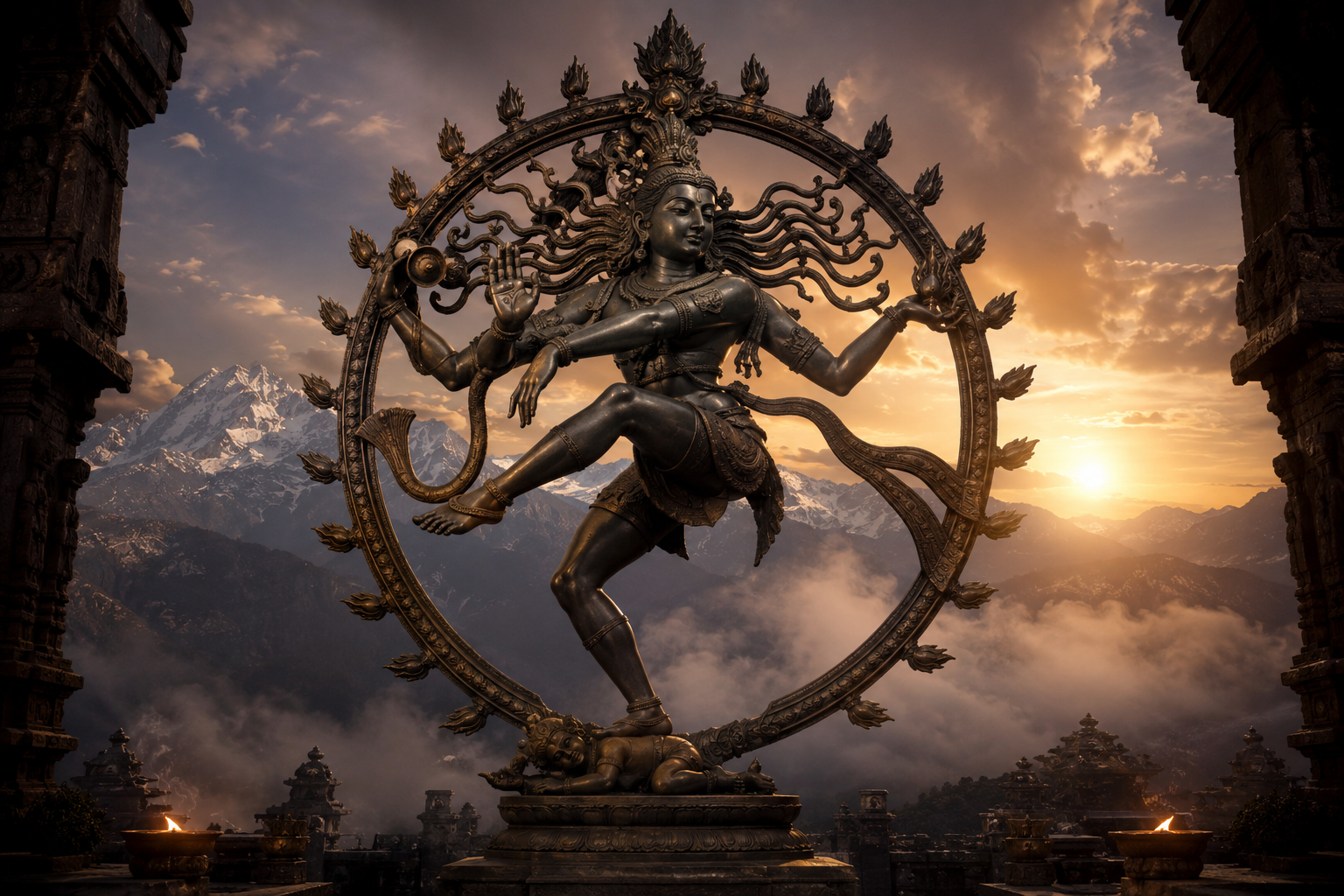
This figure was Lord Shiva, revered in yogic tradition as Adi Yogi, the First Yogi, and the original source of yogic wisdom.
For thousands of years, Shiva remained in absolute stillness. Snow fell across the mountains. Rivers carved through stone. Civilisations rose and disappeared. Yet he sat unmoving, absorbed in a state of deep awareness beyond ordinary understanding.
To those who witnessed him, he appeared distant from the world, an ascetic lost in silence. But a small group of seekers sensed that there was something extraordinary within that stillness.
Seven of them stayed.
The Seven Sages
These seekers would later become known as the Saptarishis, the Seven Sages. Drawn by an unexplainable pull toward Shiva, they devoted themselves to observing him and learning from him.
At first, Shiva ignored them completely. According to tradition, this was intentional. Yoga was never meant to be received casually. It required patience, discipline, humility and devotion. So they waited. Days became months. Months became years.
The seven sages remained unwavering in their commitment until Shiva finally recognised that they were ready to receive what he had discovered.
And this is where the story becomes especially meaningful.
Shiva may have been the Adi Yogi, but the sages were seekers.
They were the ones who had to learn.
They had to practise.
They had to wait.
They had to keep showing up.
In that sense, they were much more like us..
The First Teachings

It is said that on the night of the summer solstice, beneath an open celestial sky, Shiva turned toward the seven sages and began to teach. In that moment, the silent meditator became the first guru.
What he shared was not merely a collection of physical postures, but a complete science of human experience, a system for understanding the body, breath, mind, energy and consciousness itself. He taught practices designed to cultivate clarity, balance, awareness and freedom from suffering. Through movement, breathwork, meditation and self-study, yoga became a path not outward, but inward.
The sages studied with Shiva for many years before travelling to different regions to share these teachings.
Through generations of teachers and students, yoga gradually spread and evolved into the many forms practised around the world today.
In yogic tradition, yoga is not viewed as something invented. It is considered something received.
“At its origin, yoga was a practice of awareness.”
Beyond Physical Practice
Today, yoga is often associated with flexibility, fitness or stress relief. And while these benefits are undeniably valuable, the ancient story of Shiva reminds us that yoga was originally intended to reach far deeper than the physical body alone.
At its essence, yoga is about connection.
Connection between movement and breath.
Connection between mind and body.
Connection between the individual self and something greater.
The Sanskrit word yoga comes from the root yuj, meaning to unite. For this reason, the image of Shiva as the Adi Yogi continues to hold powerful symbolism for practitioners around the world. He represents stillness within chaos, awareness within distraction and transformation through consistent inner practice. But perhaps the Seven Sages offer an equally important message.
They remind us that yoga is a practice for seekers.
You don't have to arrive knowing everything.
You don't have to be flexible.
You don't have to be calm, enlightened or perfectly balanced.
You simply have to be willing to begin.
Why This Story Inspired Our Studio
This is where the ancient story connects with the name of our studio.
Yoga for Mortals was inspired by the idea that yoga isn't only for the extraordinary. It is for ordinary human beings.
For people who are busy, distracted, curious, tired, imperfect and still learning.
For people who come to their mat because they want to feel stronger, move more freely, breathe more deeply or simply have a little time to themselves.
The Seven Sages weren't portrayed as people who already had all the answers.
They were seekers.
They were willing to sit, listen, practise and learn.
And perhaps that's what makes their story so relevant to us today. Yoga doesn't ask us to become someone else.
It invites us to become more aware of who we already are.
Yoga began as a journey inward.
We invite you to begin your own journey with us.